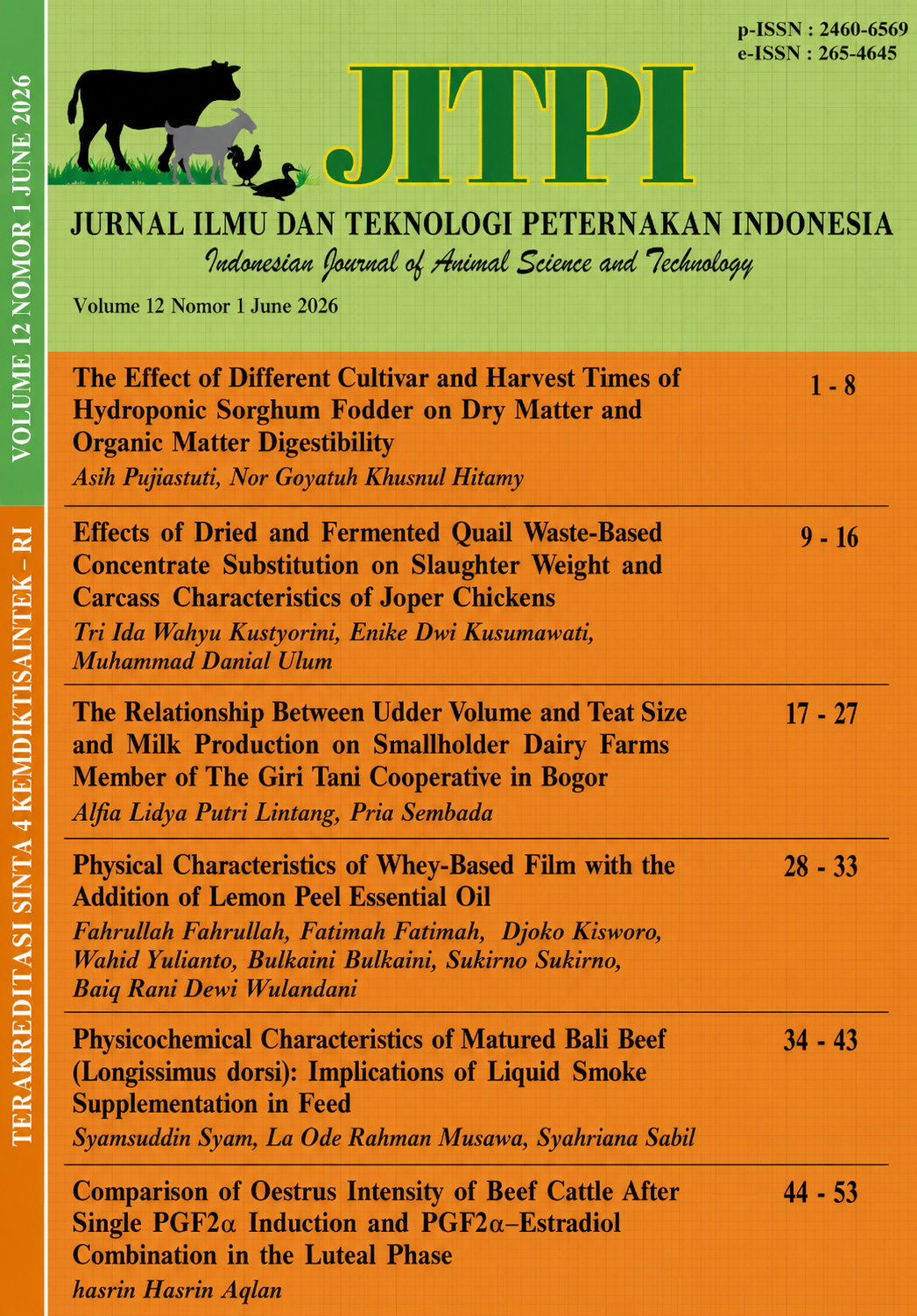
Physical Characteristics of Whey-Based Film with the Addition of Lemon Peel Essential Oil
DOI:
https://doi.org/10.29303/jitpi.v12i1.273Keywords:
Film, packaging, lemon, essential oil, wheyAbstract
Efforts to improve food quality, particularly those emphasizing sustainability and health aspects, have become a major focus in the food processing industry. This study aimed to determine the effect of different concentrations of lemon peel essential oil on the physical characteristics of whey-based films. The research was conducted using a Completely Randomized Design (CRD) with three replications. The treatments consisted of varying concentrations of lemon peel essential oil: 0% (L1), 2% (L2), and 4% (L3). Data were analyzed using Analysis of Variance (ANOVA), and when significant differences were observed, further analysis was performed using Duncan’s Multiple Range Test (DMRT). The results showed that the addition of essential oil had no significant effect (P>0.05) on film thickness and elongation, but had a significant effect (P<0.05) on tensile strength. The thickness values ranged from 0.14 to 0.16 mm, elongation ranged from 62.10% to 62.77%, and tensile strength ranged from 5.20 to 5.51 MPa. Increasing the concentration of essential oil tended to decrease the tensile strength of the film due to disruption of intermolecular protein interactions and the formation of a discontinuous phase within the film matrix. Meanwhile, the plasticizing effect of the essential oil contributed to increased film flexibility at certain concentrations, although it did not meet the minimum elongation standard. Thus, the addition of lemon essential oil affects the mechanical properties of whey-based edible films, particularly by reducing tensile strength.
Downloads
References
Al-Awwaly, K. U., Manab, A., & Wahyuni, E. (2010). Production of whey protein edible film: the study of protein and glycerol ratio on physical and chemical properties. Jurnal Ilmu dan Teknologi Hasil Ternak, 5(1).
Çakmak, H., Özselek, Y., Turan, o. Y., Firatligil, E., & Karbancioğlu-Güler, F. (2020). Whey protein isolate edible films incorporated with essential oils: Antimicrobial activity and barrier properties. Polymer Degradation and Stability, 179. https://doi.org/10.1016/j.polymdegradstab.2020.109285
Chakravartula, S. S. N., Soccio, M., Lotti, N., Balestra, F., Rosa, M. D., & Siracusa, V. (2019). Characterization of composite edible films based on pectin/alginate/whey protein concentrate. Materials (Basel), 12(15). https://doi.org/10.3390/ma12152454
Cheng, J., Velez, F. J., Singh, P., & Cui, L. (2024). Fabrication, characterization, and application of pea protein-based edible film enhanced by oregano essential oil (OEO) micro- or nano-emulsion. Current Research in Food Science, 8. https://doi.org/10.1016/j.crfs.2024.100705
Fahrullah, F., Radiati, L. E., Purwadi, & Rosyidi, D. (2020). The physical characteristics of whey based edible film added with konjac. Current Research in Nutrition and Food Science, 8(1). http://dx.doi.org/10.12944/CRNFSJ.8.1.31
Fahrullah, F., Ervandi, M., & Rosyidi, D. (2021). Characterization and antimicrobial activity of whey edible film composite enriched with clove essential oil. Tropical Animal Science Journal, 44(3). https://doi.org/10.5398/tasj.2021.44.3.369
Fahrullah, F., Noersidiq, A., Kisworo, D., & Maruddin, F. Evaluating physicochemical properties of whey-chia seed edible films for biodegradable packaging. Tropical Animal Science Journal, 47(4). https://doi.org/10.5398/tasj.2024.47.4.519
Galus, S., & Kadzińska, J. (2016). Moisture sensitivity, optical, mechanical and structural properties of whey protein-based edible films incorporated with rapeseed oil. Food Technology & Biotechnology, 54(1). https://doi.org/ https://doi.org/10.17113/ftb.54.01.16.3889
Galus, S., Mikus, M., Ciurzyńska, A., Domian, E., Kowalska, J., Marzec, A., & Kowalska, H. (2021). The Effect of Whey Protein-Based Edible Coatings Incorporated with Lemon and Lemongrass Essential Oils on the Quality Attributes of Fresh-Cut Pears during Storage. Coatings, 11(7). https://doi.org/10.3390/coatings11070745
Goungam, M. E., Xu, S., & Wang, Z. (2007). Whey protein isolate-based edible films as affected by protein concentration, glycerol ratio and pullulan addition in film formation. Journal of Food Engineering, 83(4). https://doi.org/10.1016/j.jfoodeng.2007.04.008
Hendrasty, H. K., Rahayu, W. T., & Marsudi, F. (2022). Efektivitas edible efektivitas edible film dari whey keju “mozarella” terhadap sifat fisik dan kimia keju “halloumi“ dan keju “mozarella” yang disimpan pada suhu ruang. Jurnal Agroekoteknologi Terapan, 3(2). https://doi.org/10.35791/jat.v3i2.44102
Pedro, S., Pereira, L., Domingues, F., Ramos, A., & Luis, A. (2023). Optimization of whey protein-based films incorporating Foeniculum vulgare mill. essential oil. Journal of Functional Biomaterials, 14(3). https://doi.org/10.3390/jfb14030121
Pires, A. F., Diaz, O., Cobos, A., & Pereira, C. D. (2024). A review of recent developments in edible films and coatings-focus on whey-based materials. Foods, 13(16). https://doi.org/10.3390/foods13162638
Socaciu, M., Fogarasi, M., Semeniuc, C. A., Socaci, S. A., Rotar, M. A., Mureşan, V., Pop, O. L., & Vodnar, D. C. (2020). Formulation and characterization of antimicrobial edible films based on whey protein isolate and tarragon essential oil. Polymers, 12 (8). https://doi.org/10.3390/polym12081748
Downloads
Published
Issue
Section
License
Copyright (c) 2026 Fahrullah Fahrullah, Fatimah Fatimah, Djoko Kisworo, Wahid Yulianto, Bulkaini Bulkaini, Sukirno Sukirno, Baiq Rani Dewi Wulandani

This work is licensed under a Creative Commons Attribution 4.0 International License.